Wet walls, floors and framing in Garland
Structural Drying Garland TX: Walls, Floors And Framing
Structural drying Garland TX is the part of a water job most people never see. The puddle is gone, but the drywall, the wood plates behind it and the subfloor are still holding water. Tell us what got wet and we put you in touch with a local crew that dries the building itself and proves it with readings.
- Drywall, framing and subfloors
- Hardwood and tile floors
- Daily moisture readings
- Homes, rentals and businesses
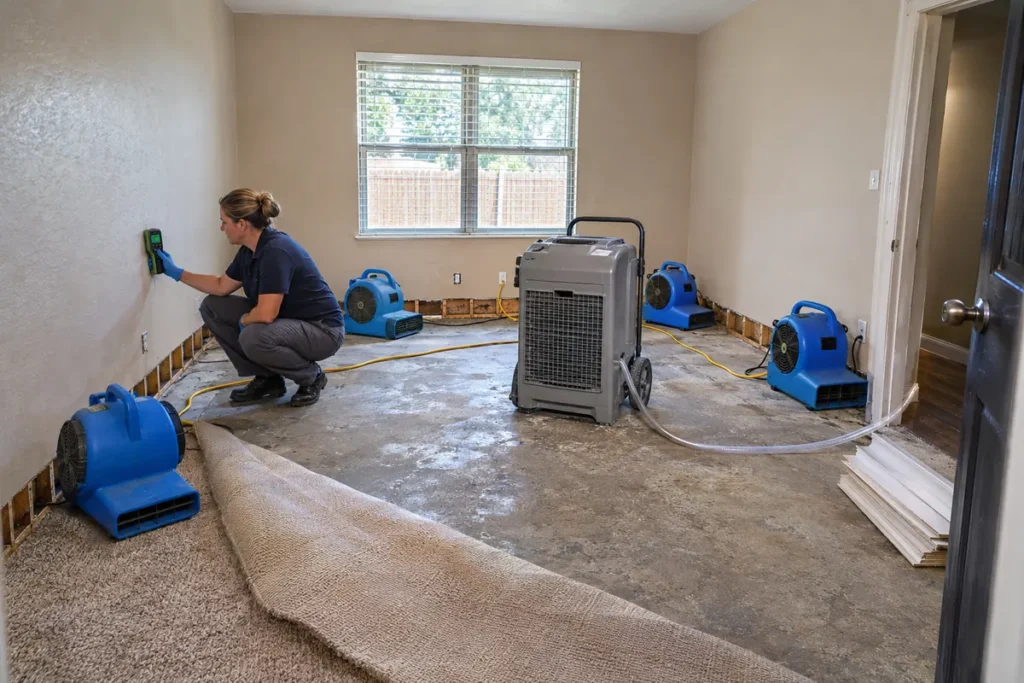
What To Do While The House Is Still Wet
You can start helping the building dry before any machine arrives.
- Get the standing water out first.Nothing dries while it sits in water. If there is still water on the floor, see water extraction.
- Keep the air conditioning running.Your AC pulls moisture out of the air. Leave it on unless the unit itself was under water.
- Open cabinets and closets.Closed spaces trap damp air. Open every door in the wet area so air can move through.
- Lift rugs and cushions off the floor.Wet fabric lying on wood or carpet keeps the surface under it soaked.
- Do not paint or seal anything.Paint, caulk and new flooring lock water inside. Wait until the readings say dry.
Structural Drying Garland TX: What It Means
A house holds water in two ways. Some of it lies on the surface, where a pump or vacuum can reach it. The rest soaks into the materials the house is built from. Structural drying is the work of taking that second kind of water back out.
It covers the parts of the building you cannot carry outside:
- Drywall and the insulation behind it
- Wall studs and the wood plates at the bottom of walls
- Plywood and OSB subfloors
- Hardwood, laminate and tile floors
- Concrete slabs
- Cabinets, baseboards and door frames
A surface can feel dry to the hand and still be wet inside. That is why this stage is run by meter readings, not by touch.
How Structural Drying Works, Step By Step
The method follows the ANSI/IICRC S500 standard that restoration crews are trained on.
- Measure everything.The crew reads the wet materials and a dry room in the same house. The dry room sets the target.
- Place the equipment.Air movers push air across wet surfaces. Dehumidifiers pull the moisture out of that air and drain it away.
- Open hidden spaces.Baseboards come off and small holes are made so air can reach inside walls and under cabinets.
- Check and adjust every day.Readings are taken daily. Machines are moved or removed as each area reaches its target.
- Confirm and remove.When wet areas match the dry room, the equipment comes out and repairs can begin.
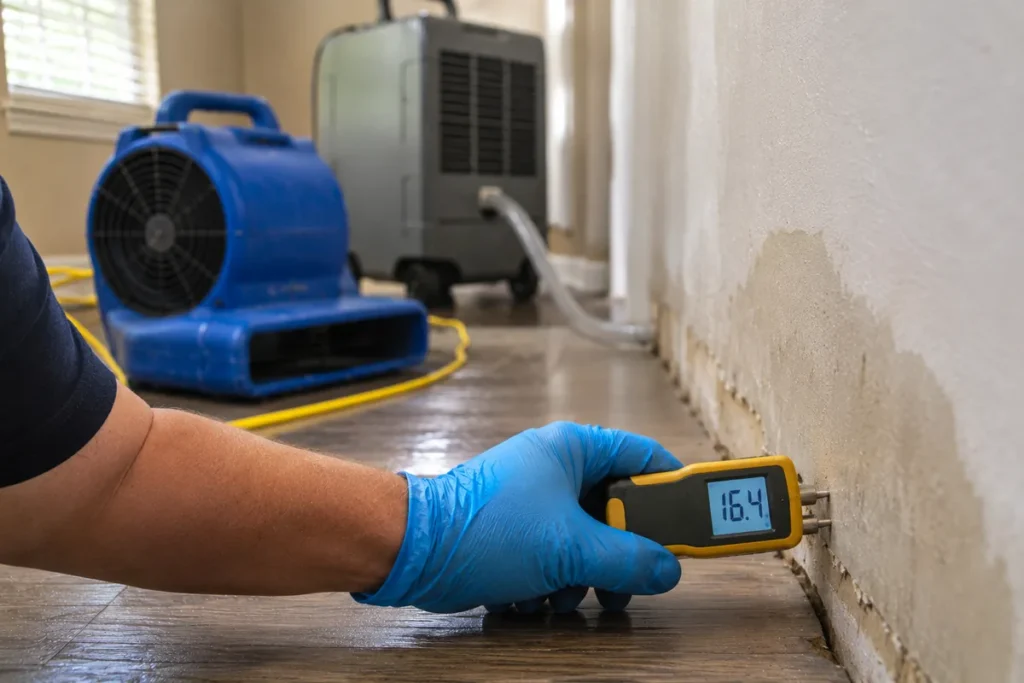
Standard: IICRC, ANSI/IICRC S500 Standard.
Drying Equipment And What Each Machine Does
If machines are placed in your home, you should know what each one is for.
| Machine | What it does | Used for |
|---|---|---|
| Air mover | Blows fast air across wet surfaces | Carpet, walls and floors |
| Refrigerant dehumidifier | Condenses moisture out of the air | Most homes in warm weather |
| Desiccant dehumidifier | Absorbs moisture and produces very dry air | Cool rooms, hardwood and dense materials |
| Floor drying mats | Pull moisture up through floor boards | Hardwood floors that can be saved |
| Wall cavity system | Sends dry air into walls through small holes | Wet insulation and studs |
| Air scrubber | Filters dust and spores from the air | Jobs with dirty water or mold |
How Long Structural Drying Takes
Most clean water jobs are dry in about three to five days. That is a common range, not a promise. Carpet and drywall give up water quickly. Hardwood, plaster and concrete give it up slowly and can take longer.
Three things set the pace: how long the water sat before work began, how much material is wet, and how well the room can be closed off so the machines can do their job. The machines run day and night. Turning them off to sleep adds days to the job.
How A Crew Proves The Structure Is Dry
You should not have to take anyone’s word for it. A proper drying job leaves a paper trail:
- A drawing or list of every wet area found on day one
- Moisture readings for each area, written down every day
- Readings from a dry room, used as the target
- Temperature and humidity in the house each day
- Final readings showing wet areas now match the dry room
Ask for a copy of this drying log. Insurers ask for it, and it is your proof if a problem shows up later.
What Can Be Dried In Place And What Comes Out
Drying in place saves money and time, but it is not right for every material.
Often Dried In Place
- Drywall wet by clean water for a short time
- Wood studs and plates
- Solid hardwood floors caught early
- Concrete slabs and tile
Usually Removed
- Drywall that has sagged or crumbled
- Wet insulation that has packed down
- Swollen laminate and particle board
- Anything soaked by sewage or flood water
What Structural Drying Costs In Garland
National figures, shown as a guide. Drying well is cheaper than replacing what was not dried.
| Item | Typical cost |
|---|---|
| Clean water cleanup, per square foot | $3.50 |
| Drywall repair, per wall | $300 to $850 |
| Ceiling repair | $450 to $1,600 |
| Flooring, per room | $200 to $3,000 |
| Mold removal | $1,200 to $3,800 |
The last row is the one to notice. A few more days of drying costs far less than mold work later. See the Garland cost guide for more detail.
Why Box Fans And Open Windows Fall Short
A box fan moves air, but it does not take water out of the air. In a closed wet room the air fills with moisture and drying slows to a crawl. Opening windows can make it worse on a humid North Texas day, because you let damp air in.
Drying needs both parts together: moving air to lift water off the surface, and a dehumidifier to carry it out of the house. The EPA advises drying wet materials within 24 to 48 hours to prevent mold growth, and fans alone rarely manage that inside a wall.
Source: US EPA, Mold Information.
Signs A Home Was Not Dried Properly
These tend to show up two to six weeks after a leak that was only mopped up.
- A musty smell that returns when the house is closed
- Wood floor boards that cup or lift at the edges
- Baseboards pulling away from the wall
- Paint that bubbles or a stain that comes back
- Dark spots along the bottom of a wall
If you see these, the structure still holds water. If spots have appeared, read our mold removal page as well.
Will Insurance Cover Structural Drying?
When the water damage itself is covered, the drying is normally part of the same claim. The Texas Department of Insurance says most homeowners policies cover sudden and accidental water damage. Damage from a slow leak or from outside flooding is usually not covered by a standard policy.
Keep the drying log and every invoice. More help is in the insurance claim guide.
Source: Texas Department of Insurance, Homeowners Insurance FAQ.
Areas We Cover In Garland
We take requests from every Garland ZIP code, 75040 to 75044.
Structural Drying Garland TX Questions And Answers
Can I turn the machines off at night?
Please do not. Structural drying only works when the equipment runs without a break. Every hour off lets moisture settle back into the materials.
Do walls always have to be cut open?
No. Clean water caught early can often be dried through small holes behind the baseboard. Walls are opened when insulation is soaked or the water was dirty.
Can we stay in the house during drying?
In most clean water jobs, yes. The machines are loud and warm, so many families sleep in a room away from the work area.
Is drying needed if the floor looks dry?
Looks do not tell you. Water sits under flooring and inside walls long after the surface dries. A moisture reading is the only way to know.
Are you the company that does the work?
No. Fix Water Damage Garland TX is a referral service. We pass your details to an independent local restoration crew, and that crew quotes, does the work and bills you or your insurer directly. The full process is on our water damage restoration page.
Send Us The Details
Write what happened, where in Garland, and when it started. A short message is enough to get things moving.
Our message line is being connected. Please check this page again soon.